22. Surah Al Hajj (The Hajj)....78 VERSES

kalamazoo

'Millat "IBRAHIM" {AleyhiSalaam}
52-54

And, O Muhammad, (it has always been so with) every Messenger and Prophet *96 We sent before you that whenever he had a desire, *97 Satan tried to interfere with his desire. *98 But Allah eradicates the mischiefs worked by Satan and confirms His Revelations, *99 for Allah is All-Knowing, All-Wise, *100 (He allows this) so that He may make Satan's obstacles a trial for those, whose hearts suffer from the disease (of hypocrisy) and whose hearts are false--the fact is that these unjust people have gone far away in their enmity- and so that those who have knowledge may realize that this (Message) is the Truth from Allah and may believe in it, and their hearts may submit humbly to it. Most surely Allah always guides the Believers to the Straight Way. *101


*96 For the distinction between Nabi and Rasul, refer to E. N. 30 of Chapter XIX (Maryam).

*97 The Arabic word tamanna has two meanings: "desire" and "to recite" something.


*98 If the first meaning is taken, it will imply:
"Satan tried to prevent the fulfilment of his desire."

If the second meaning is taken, it will imply:
"When the Prophet recited the Revelations, Satan created different sorts of doubts about its truth and meanings in the minds of the people."

*99 If the first meaning is adopted, it will imply: "Allah fulfils the Prophet's desire and makes his Mission successful in spite of the obstacles of Satan and confirms the truth of His Revelations by fulfilling His promises to the Prophet".

In case of the second meaning, it will imply:

"Allah eradicates all the doubts and objections inspired by Satan in the hearts of the people and clarifies the confusion created about any verse of the Qur'an in subsequent Revelations".

*100 "Allah is All-Knowing" and has full knowledge of the mischief worked by Satan and of its effects, and being ;'All-Wise", He counteracts every mischief of Satan.


*101 That is,

"Allah lets Satan work such mischiefs to put to the test both the righteous and the wicked people".

The people with a perverted mentality deduce wrong conclusions from these and deviate from the Right Way, while those, who think on the right lines, realize that all these things are the mischiefs of Satan and that the Message of the Prophet is based on the Truth. They conclude that the very fact that Satan has been so much agitated and become active against it is a clear proof of its being the Truth. It is very important to understand the real significance of this passage (vv. 52-54) for this has given rise to a grave misunderstanding .

If we consider it in the context in which it occurs, it becomes obvious that it was sent down to refute the wrong appraisal of the casual observers that the Holy Prophet had "failed" to achieve his desired object. This was because he had striven for thirteen long years to persuade his people to accept his Message but the apparent result was that he had not only failed in this, but he and the small band of his followers had been forced to leave their homes. As this "exile" contradicted his claim that he was a Prophet of Allah and had His approval and succour with him, some people became sceptical about it. Moreover, they became doubtful about the truth of the Qur'an, because they were not being visited by the scourge, which was inflicted on those who treated the Prophet as false. His antagonists scoffed at him, saying, "Where is that succour of Allah and the scourge with which we were threatened?"

The answer to these doubts of the disbelievers was given in the preceding passage, and in this passage the addressees were those who were influenced by this propaganda. Briefly the whole answer was to this effect:

"lt is not a new thing that the people of a Messenger have treated him as an impostor for it has always been happening like this: You can see from the remnants of those peoples who treated their Messengers as impostors how they were punished for their mischief. You can learn a lesson from them, if you will. As regards the delay in the coming of scourge, the Qur'an never threatened the disbelievers • with immediate punishment, nor is it the job of the Messenger to inflict punishments. The scourge is sent by Allah, but He is not hasty in sending His torment. He gives respite to the people to mend their ways as He is giving you now. Therefore, you should not be under any delusion that the threats of scourge are empty threats.

"It is also not a new thing that the desires and wishes of a Prophet meet with obstacles or that false propaganda is made against his Message for the same has already happened with regard to the Messages of the former Prophets. But ultimately Allah eradicated the mischief worked by Satan and made the Message successful. Therefore you should take a warning from the past history of Satan's mischiefs and their ultimate failure.
You should note it well that the obstacles and the mischiefs of Satan are a trial and means that help attract the righteous people towards Islam and winnow the dishonest people away from it" .

It is a pity that in spite of the above clear and simple meaning of the passage which fits in well with the context, a grave misunderstanding has arisen because of a tradition which has not only changed its meaning entirely and rendered it irrelevant in the context but has helped make doubtful the very basic Articles of the Faith. Therefore we are making a critical appraisal of the tradition in order to show how to make the right use of traditions for the correct interpretation of the Qur'an.

According to this tradition, the Holy Prophet had a strong longing and desire to this effect:

"I wish some Revelations were sent down to tone down the abhorrence of the mushrik Quraish against Islam so as to bring them nearer to it, or at least the criticism against their creed may not be so severe as to arouse their enmity" .

While he was cherishing this desire, it so happened that one day when he was sitting in a big gathering of the Quraish, Surah An-Najm (LIII) was sent down and he began to recite it.

When he came to vv. 19, 20: "Have you ever considered about this Lat and this `Uzza, and a third (goddess) Manat, "all of a sudden he recited, "These are exalted goddesses; indeed their intercession may be expected". After this he continued to recite Surah An-Najm up to the last verse and then fell down in prostration and all the Muslims and the mushriks of the Quraish also did the same, for the latter said, "Now we have no difference with Muhammad; we also profess that Allah is the Creator and the Provider and that these deities of ours are merely our intercessors with Him" .

After this, when in the evening Angel Gabriel came, he said, "What have you done? I did not bring these two sentences". At this the Holy Prophet became very sad and Allah sent down vv. 73 75 of Surah Bani Isra`il (XVII): "O Muhammad! these people have left no stone unturned to tempt you away from that which We have revealed to you so that you might fabricate something in Our name. Had you done that, they would have made you their friend. It was just possible that you might have inclined a little towards them, if We had not given you strength. But if you had done so, We would have made you taste double chastisement in this world as well as in the Hereafter: then you would have found no helper against Us".
But in spite of this, he continued to be grieved till Allah sent down v. 52 of this Surah (Al-Hajj) in which Allah consoled him, saying that the same had been happening to the former Prophets.

Another thing that happened in the meantime was that the story reached the migrants to Habash that there had been a reconciliation between the Holy Prophet and the disbelievers of Makkah. Accordingly, many of them returned to Makkah only to learn that the news of reconciliation was wrong and the conflict between Islam and kufr was raging as furiously as before.


Now let us make a critical study of this story which has been cited by Ibn Jarir and many other commentators and is even contained in many collections of Traditions.

................to be continued...Inshaa Allah
 

kalamazoo

'Millat "IBRAHIM" {AleyhiSalaam}
in continuation

(1) None of its reporters, except Ibn `Abbas, is a Companion.
(2) There are many major discrepancies and variations in its details.
(3) The wording ascribed to the Holy Prophet in praise of the idols in each

Tradition is different from that of others.

Moreover, these words have been attributed to different sources according to different Traditions:
(a) These words were put in by Satan during the Revelation and the Holy Prophet imagined that they were revealed by Gabriel.
(b) He himself uttered these words inadvertently, being urged by his own desire. (c) He was dozing when he uttered these words.
(d) He intentionally uttered these words but in a manner as to question their veracity.
(e) Satan interpolated these words into the Revelation, giving an impression that the Holy Prophet himself had recited them.
(f) It was one of the mushriks who had recited these words.

Yet scholars of Tradition like Hafiz Ibn Hajar and jurists like Abu Bakr alJassas and rationalists like Zamakhshari and commentators like Ibn Jarir accept this story as true and consider it as a commentary on verse 52 of this Surah. Ibn Hajar argues like this:

"Even though the links by which this Tradition has been related are either weak or "broken", except in one case, the very fact that it has been related through so many "links" is a proof that there is some truth about it. The one which has strong links is by Said bin Jubair who has related it from Ibn `Abbas and the reporters of two more Traditions (which have been cited by Tabari) have been declared authentic by Bukhari and Muslim".

On the other side, there are other eminent scholars who declare this story to be utterly baseless. Ibn Kathir says,

"All the links of this Tradition are unauthentic and I have found no correct version of this with continuous links". Baihaqi says, "This story has not been proved to be correct by the rules of reporting".

When Ibn Khuzaimah was asked about it, he said, "This story has been invented by heret cs"
Qazi `Ayad says,

"The very fact that this Tradition is neither contained in any of the six authentic collections of Hadith nor has it been related in an authentic way by authentic reporters shows its weakness". Besides them, Imam Razi, Qazi Abu Bakr Ibn al-`Arabi, Alusi etc. have rejected it altogether.

It is a pity that even those who reject this story have not done full justice to their cases. There are some who reject it because its "links" are weak. In other words, they would have accepted it, if its links were strong. Then there are others who reject it because its acceptance makes the whole Faith doubtful.

This kind of reasoning may satisfy the believers but it cannot satisfy those who are already sceptical or intend to make a research into it with a view to making a correct appraisal of Islam. They will rather say, "When a story is related by an eminent Companion and is contained in the collections of Traditions, there is no reason why we should reject it just because it makes your Faith doubtful".


Now let us consider the story critically and rationally to prove that it is unacceptable.

(1) Its internal evidence proves it to be wrong:

(a) According to the story the incident happened after the first migration to Habash, for according to it some of the migrants returned to Makkah after hearing the story.

Now the fact is that the migration took place in the month of Rajab of the fifth year of Prophethood and some of the migrants returned to Makkah three months later, i.e. in Shawwal of the same year.

(b) Verses 73-75 of Chapter XVII in which the Holy Prophet was "reproved" for this incident were revealed in the eleventh or twelfth year of Prophethood. In other words, he was "reproved" by Allah five or six years after the incident.
(c) This verse (52) in which the interpolation by Satan was abrogated was sent down in the first year of Hijrah, i.e. about two years after the reproof. Can a person in his senses believe' that the Holy Prophet 'was reproved for the interpolation after six years, and it was abrogated after nine years ?
(2) According to the story, this interpolation was made in Surah An-Najm. When the Holy Prophet was reciting the words, "And a third (goddess) Manat'; he also recited the interpolated sentence, and then continued the recital up to the end of the Surah. It is said that the disbelievers of Makkah were so pleased with the interpolation that they declared, "The differences between us and Muhammad (Allah's peace be upon him) have now come to an end".

..to be continued...Inshaa Allah


kalamazoo

'Millat "IBRAHIM" {AleyhiSalaam}
Let us now read w. 19-23 of An-Najm along with the alleged interpolation (in italics):

"Have you ever considered about the reality of this Lat and ` Uzza and a third (goddess) Manat? These are exalted goddesses; indeed their intercession may be expected. What, do you have sons for yourselves add daughters for Him (Allah) ? This is indeed an unfair division. They are nothing but mere names which you and your forefathers have invented. Allah has sent down no authority in regard to them. They follow only conjectures and the whims of their own minds, although right guidance has come from their Lord".


Even a casual reader will detect an obvious
contradiction in the passage. Immediately after "praising" the goddesses there is a hard hit on their worshippers, as if to say:

"O foolish people! How is it that you have ascribed daughters to Allah and sons to yourselves? All this is your own invention which has no authority from Allah" .

On the face of it, the interpolation makes the passage absurd which cannot be assigned even to a rational person not to speak of Allah. Then the story presumes that all the Quraish who were listening to it must have lost their senses; otherwise they could not have declared that their differences with Muhammad (Allah's peace be upon him) had been made up from thence.

From this internal evidence it has become clear that this story is absurd and meaningless.

(3) Now let us consider whether the occasions ascribed by the commentators to the revelation of the verses under discussion, fit in with the chronological order of the Qur'an. According to the story, the interpolation in Surah AnNajm (LIII) was made in the fifth year of Prophethood; the reproof was made in vv. 73-75 of Bani Isra'il (XV11) and then the interpolation was annulled and the incident explained in vv. 52-54 of Surah Al-Hajj (XXII).

Now there could be only two possibilities about the time of their revelation: either the verses containing the reproof and the abrogation were sent down in the period in which the interpolation took place, or the verse containing the reproof was sent down along with Surah Al-Hajj (XXII). In the first case, the question arises: Why were these verses (XVII: 73-75) not inserted in An-Najm (LIII)? Why were they held in abeyance for six long years and then inserted in Surah Bani Isra'il (XVII), when it was revealed, and vv. 52-54 (containing the abrogation) inserted in Surah Al-Hajj (XXII) after a further delay of more than two years?

Dces it mean that the verses were sent down on one occasion and inserted years later haphazardly in one Surah or the other?
In the second case, the question would arise: Does it stand to reason that the verses containing the reproof (XVII: 73-75) were sent down six years after the interpolation, and the verse of abrogation (XXII: 52) nine years after the incident?

Still another question arises: What was the occasion of the revelation of the verses of reproof and abrogation in Chapters XVII and XXII in the context in which they occur?

(4) Now let us turn to the third principle of correct appraisal of the Qur'an.

For a correct appreciation of the Qur'an it is essential to consider whether a particular commentary fits in with the relevant context of the Qur'an or not. If we make even a cursory study of XVII: 71-73, (Bani Isra'il), it will become obvious that there was no occasion for the alleged reproof in v. 73 and that there is no tinge of reproof in it, for the words of the verse refute the allegation that the Prophet was taken in by the mischief of the disbelivers. Then in Surah AI-Hajj (XXII), if we make a critical study of the verses that precede vv. 52-54 and follow them, it will become obvious that there was no occasion to console the Prophet for the "interpolation" and to annul it after nine years.

..to be continued...Inshaa Allah.


kalamazoo

'Millat "IBRAHIM" {AleyhiSalaam}
(5) We reiterate that no Tradition, however strong links it might have, can be accepted when the Text itself is a clear evidence against it, and when it does not fit in with the wording, the context, the order etc. of the Qur'an. When the incident is considered in this background, even a sceptical research scholar would be convinced that the Tradition is absolutely wrong.

As regards a believer, he can never accept it, when he knows that it contradicts not only one verse but a large number of other verses of the Qur'an. He would rather believe, that the reporters of the Tradition might have been deluded by Satan and not the Holy Prophet. He would never believe that the Holy Prophet could interpolate even a single word in the Qur'an under the influence of a desire of his own: or that there could ever occur such a desire in his mind that he should make a compromise with the disbelievers by associating shirk with Tauhid: or that he could ever wish that Allah might not say anything to displease the disbelievers: or that the Revelation was made in such an unsafe and doubtful manner as to enable Satan to mix with it even a word in a manner as if it was also brought by Gabriel.

Each of these things is contradictory to the clear Revelation of the Qur'an and the basic Articles of the Faith which we have learnt from the Qur'an and the Holy Prophet.

God forbid that we should accept any such Tradition that might lead to the above mentioned presumptions just because the Tradition seems to be "authentic" in every way.

It will be worth-while to consider the question:

How is it that so many reporters of Traditions have related this story?
Dces it not show that there must have been some reality about it?
Otherwise, so many reporters, who included many authentic and eminent scholars, could not have made such an heinous slander against the Qur'an and the Holy Prophet.

Its answer is contained in the authentic collections of Traditions by Bukhari, Muslim, Abu Dawud, Nasa`i and Musnad Ahmad. The reality of the incident is this:

The Holy Prophet recited Surah An-Najm and performed prostration at the end of it. At this, all the hearers, both the Muslims and the mushriks, fell down in prostration. This was what really happened and there is nothing strange about-it. Let us depict the occasion: The Holy Prophet was reciting a forceful piece of the eloquent Qur'an in a very impressive manner. Naturally the occasion produced an emotional effect and all the listeners instinctively fell down in prostration along with him. It was because of such ecstasies produced by the Holy Prophet's recital of the Qur'an as this that the disbelievers dubbed him a "sorcerer". As regards the story that the Holy Prophet praised the deities of the disbelievers, it appears that the Quraish concocted the story to hide their "defeat". Probably someone or other of them explained away their defeat, saying, "We ourselves heard Muhammad praising our deities. Therefore we also fell down in prostration along with him".

As regards the migrants to Habash, they returned to Makkah when they heard the concocted story that there had been a compromise between the Holy Prophet and the Quraish. It appears that some of those people who had seen the Muslims and the mushriks falling down together in prostration, presumed that peace had been made between them, so the story travelled to the migrants in Habash who had no means to verify it and thus thirty-three of them returned to Makkah.

Naturally these three things-prostration by the Quraish, their explanation of it, and the return of the migrants from Habash-combined to evolve that story. So much so that some authentic people were also deluded by it, for to err is human, and the pious and intelligent people are no exception to it.

However, the error of the latter proves to be more harmful, because their credulous followers accept with closed eyes their misconceptions along with their right conclusions. On the other hand, mischief mongers collect all such errors of the righteous people and exploit them to prove that all the collections of Traditions are false and should be rejected forthwith.


kalamazoo

'Millat "IBRAHIM" {AleyhiSalaam}
[55-60]

Yet the disbelievers will always remain in doubt about it until the Hour of Resurrection overtakes them suddenly or the scourge of a "barren" day *102 descends upon them. On that Day Allah will reign supreme, and He will judge between them; then those who will have believed and done righteous works, will go to the Gardens of Bliss,but those who will have disbelieved and treated Our Revelations as false, shall receive an ignominious punishment. As for those, who left their homes for the sake of Allah and then were killed or died, Allah will make for them a generous provision) and Allah is the best of Providers.He will admit them to a place with which they will be well pleased; indeed Allah is All-Knowing and Clement.' *103 This is about them. As regards the one, who takes vengeance equal to the wrong that had been done to him, and has again been oppressed, Allah will surely help him *104 : Allah is Forgiving and Forbearing. *105

*102 The epithet "barren" has been applied to the "day" in its metaphorical and not literal sense. :A "day" is barren if all the plans, hopes and devices remain unproductive in it, or it dces not bring forth its night. For instance, the days on which the people of Prophet Noah, the tribes of `Ad and _Thamud, the people of Lot and of Midian met with their destruction by scourge from Allah, were barren days in this sense, because those days did not bring forth any "tomorrow" for them, and no device of theirs could avert their doom.

*103 As Allah is All-Knowing, He knows well those who left their homes for His sake and what reward they deserve. He is Clement, and forgives minor errors and weaknesses of the people; therefore these things will not hinder Him from rewarding the Believers for their services and sacrifices.

*104 The preceding verses referred to those persecuted people who could not retaliate and here 'the reference is to those victims of persecution who could fight back.
From this verse, Imam Shafi`i has concluded that "retaliation" will be effected in the way as life was taken in the original act. If a person is killed by immersion in water, the killer also should be put to death by immersion in water; or if a person is .burnt to death, the killer also will be burnt to death. The Hanafites dispute this. According to them, retaliation against a murderer will be incurred in one and the same established way no matter how life was taken by the culprit in the original act.

*105 This verse (60) may imply two things:
(1) Allah forgives that "killing" which is done in self-defence, though killing of people is not a good thing in itself.
(2) As Allah, Whose slaves the Believers are, is Forgiving and Forbearing, they should also forgive and forbear as far as possible. Though they have the right of retaliation, they should not resort to carnage and massacre.
 

kalamazoo

'Millat "IBRAHIM" {AleyhiSalaam}
[61-64]

So it is *106 because it is Allah Who brings forth the day from the night and the night from the day *107 and He hears everything and sees everything. *108 This is so because it is Allah alone Who is the Truth and all others, whom they invoke besides Him, are falsehood, *109 and Allah is the Supreme and the Exalted One. Do you not see that Allah sends down rain water from the sky and the land becomes green because of it? *110 The fact is that Allah works in imperceptible ways and is fully aware of everything. *111To Him belongs all that is in the heavens and the earth and undoubtedly Allah is All-Sufficient and All-Praiseworthy. *112


*106 "So it is" (as stated in the preceding paragraph) because Allah is the Ruler of the universe and has the power to give punishments and rewards to those who deserve them.

*107 The fact that "Allah brings forth .........day" is a proof that He is the Master, Sovereign and Ruler of the universe. But the deeper meaning of the verse is that Allah, Who is able to bring forth the light of the day out of the darkness of the night, has the power to bring out the light of the Truth out of the darkness of disbelief and ignorance, and the light of justice out of the darkness of tyranny.

*108 He hears everything and sees everything and is not unaware of anything.

*109 As Allah is in fact the Sovereign of the universe, His worshippers will surely attain true success and the worshippers of false gods will meet with utter failure.

110 This verse has a deeper meaning also, though apparently it merely declares that Allah alone has the power to send down rain which makes the land green. The deeper meaning is that the rainfall of the blessed Revelation will, in the near future, turn the barren land of Arabia into a garden of knowledge, morality and bring forth a high and righteous civilization.

*111 The original word Latif in the Text has no equivalent in English. The word "subtle" has not been used because of its bad associations. Latif implies that Allah fulfils His designs in such fine ways that it is difficult to understand them till they become real and apparent.
As He is fully aware of everything, He knows how to conduct the affairs of His Kingdom.


*112 He alone is "All-Sufficient" and does not stand in need of anyone in any way. He is "All-praiseworthy" because all praise belongs to Him alone whether anyone praises Him or not. __________________
 

kalamazoo

'Millat "IBRAHIM" {AleyhiSalaam}
[65-66]

Do you not see that He has subdued to you all that is in the earth and that He has subjected the boat to the law that she floats over the sea at His bidding, and He is supporting the sky in a way that it cannot fall down without His permission ? *113 The fact of the matter is that Allah is very Kind and Merciful to the people. He it is Who has given you life and causes your death, and He will again bring you to life; yet Man denies the Truth. *114

*113 Here "the sky" implies the whole of the universe above and below the earth where everything is held in its own place and sphere.


*114 That is, "Though man sees every reality presented by the Prophets, yet he denies it".
 

kalamazoo

'Millat "IBRAHIM" {AleyhiSalaam}
[67-70]

[67-70]

For every community *115 We have prescribed a way of worship, *116 which it follows; therefore, O Muhammad, let them not dispute with you concerning this matter. *117 And invite the people to the Way of your Lord, for you are on the Straight Way. *118 And if they dispute with you, say to them, "Allah knows full well what you are doing: on, the Day of Resurrection, Allah will judge between you concerning that about which you differ". Do you not know that Allah has full knowledge of everything in the heavens and the earth ? Every thing has been recorded in a Book; this is an easy thing for Allah. *11


*115 That is, "The Community of every Prophet" .
*116 Here the Arabic word mansak has been used in its most comprehensive sense which also includes "sacrifice" (v. 34). It means service, worship, in short, "the whole way of life". The same theme has been expressed in V: 48: "We prescribed a law and a way of life for each of you".​


*117 That is, "Now you have brought a way of life just as the former Prophets brought "ways of life" for their people. Therefore the people have no right to dispute with you concerning the "Law" you have brought".

*118 This confirms the explanation given in E.N. 117 above.

*119 In order to understand the significance of this paragraph, we should keep in view vv. 55- 57 with which this is connected.


kalamazoo

'Millat "IBRAHIM" {AleyhiSalaam}
[71-72]

They worship, besides Allah, those for whom He has sent down no authority nor they themselves have any knowledge about them. *120 Such transgressors have no helper. *121 And when Our clear Revelations are recited to them, you perceive signs of disdain in the faces of the disbelievers as though they were going to assault those who recite Our Revelations to them. Say to them, "May I inform you of a thing worse than this? *122 It is the Fire which Allah has promised for those who reject the Truth; and what an evil abode it is !"
120 That is, "Neither there is any mention of their deities in any revealed Book nor have they any other source of knowledge about them nor any authority to worship them. Therefore, it is sheer ignorance that they have associated their self invented deities with Allah and worship them, make vows and offer sacrifices to them and supplicate them for their needs etc.

*121 This is to warn the foolish people that they are absolutely wrong in expecting that their deities would help them in this world and in the Hereafter? because they have no power to help them. Thus, they will find no helper, for Allah alone could help them and they have already displeased Him by their rebellious behaviour.

*122 That is, "You will meet with a far worse state of anguish than that which you display against those who recite Divine Revelations to you.
 

kalamazoo

'Millat "IBRAHIM" {AleyhiSalaam}
[73-74]

يَا أَيُّهَا النَّاسُ ضُرِبَ مَثَلٌ فَاسْتَمِعُوا لَهُ إِنَّ الَّذِينَ تَدْعُونَ مِنْ دُونِ اللَّهِ لَنْ يَخْلُقُوا ذُبَابًا وَلَوِ اجْتَمَعُوا لَهُ وَإِنْ يَسْلُبْهُمُ الذُّبَابُ شَيْئًا لَا يَسْتَنْقِذُوهُ مِنْهُ ضَعُفَ الطَّالِبُ وَالْمَطْلُوبُ ﴿22:73﴾

(22:73) O mankind! A parable is related to you: so listen to it. The deities, whom you invoke instead of Allah, cannot create a fly even though they may all combine together for this purpose. Nay ! if a fly snatches away something from them, they cannot get it back from it. How weak are the suppliants and how weak those whom they supplicate. *123
مَا قَدَرُوا اللَّهَ حَقَّ قَدْرِهِ إِنَّ اللَّهَ لَقَوِيٌّ عَزِيزٌ ﴿
(22:74) They do not recognize the true worth of Allah' as they should: the fact is that Allah alone is All-Mighty, All-Powerful.

*123

This parable has been cited to impress upon the idol-worshippers that their deities are absolutely powerless, for even if they all collaborated to create an insignificant thing like a fly, they could not; nay, even if a fly snatched away anything from them they could not prevent it. This shows how weak they themselves are and how powerless are the idols they supplicate.
 

kalamazoo

'Millat "IBRAHIM" {AleyhiSalaam}
[75-76

Allah chooses His Messengers from among the angels and also from among the human beings (to convey His decrees). *124 He hears everything and knows everything. He knows whatever is open before them as well as that which is hidden from them, *125 and all matters are resented before Him. *126


*124 In continuation of the refutation of shirk, Allah has taken two kinds of the most revered of "deities" to show their real status, as if to say, "The angels and the Prophets whom you have set up as deities are mere Messengers of Allah. Allah has chosen them to convey His Messages to human beings and this does not make them God or partners in His Godhead. "

*125 The Qur'an employs this sentence to refute the creed of the mushriks in regard to intercession, as if to say, "You imagine that angels, prophets, saints,and the like can intercede with Allah on your behalf and therefore you worship them. You are absolutely wrong, for none of your deities knows what is good for you and what is not: Allah alone hears everything, sees everything and knows everything. Therefore He has not given the right of intercession and recommendation to anyone except when He Himself is pleased to give such permission."

*126 This is to impress upon them that every affair and every matter, big or small, is presented before Allah for a decision. Therefore you should not invoke anyone else than Allah, for all others are utterly helpless and powerless and cannot even fulfil their own desires and needs.
 

kalamazoo

'Millat "IBRAHIM" {AleyhiSalaam}
[77-78]

index_html_22b51387.jpg
index_html_m41f0bd68.jpg
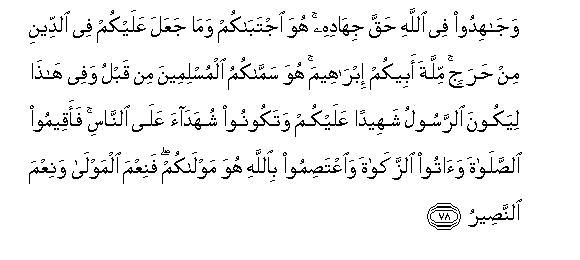
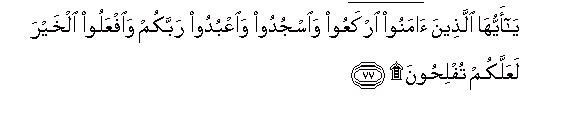
O people, who have believed, bow down and prostrate yourselves before Allah, worship your Lord and do righteous deeds: it may be that you attain true success. *127 Exert your utmost for the cause of Allah as one should. *128 He has chosen you for His service *129 and has not laid on you any hardship in your religion. *130 Therefore, be steadfast in the religion of your father Abraham *131 . Allah had called you "Muslims" before this and has called you *132 (by the same name) in this (Qur'an) also so that the Messenger may be a witness in regard to you and you may be witnesses in regard to the rest of mankind. *133 Therefore, establish Salat and pay the Zakat dues, and hold fast to Allah, *134 for He is your Guardian: What an excellent Guardian and what an excellent Helper!
*127 This is the right way of attaining we success, but even after adopting these ways of worship and performing good deeds one should not rest content or be proud that he would surely attain success because he is worshipping Allah and is doing good deeds. He should only expect that Allah will by His grace accept his services and bless him with we success.

Imam Shafi`i, Ahmad bin Hanbal, `Abdullah bin Mubarak and Ishaq bin Rahawayah hold the view that this verse of Surah Al-Hajj requires a `prostration'. But Imam 'Abu Hanifah, Imam Malik, Hasan Basri, Said bin al-Musayyab, Said bin Jubair, Ibrahim Nakha`i and Sufyan Thauri dispute this. The arguments of the two sides are briefly as follows:

The former group of commentators base their opinion on the following:
(1) The verb in the verse is in the imperative mood.
(2) The Tradition of `Uqbah bin `Amir, which has been reported by Imam Ahmad, Abu Dawud, Tirmizi, Ibn Marduyah and Baihaqi, says, "I asked, `O Messenger of Allah ! Dces the merit of Surah Al-Hajj consist in the fact that it contains two verses requiring prostration?' He replied, `Yes, the one who does not prostrate on these two verses, should not recite them.' "
(3) The Tradition of Abu Dawud and Ibn Majah in which `Amr bin `As says that he was told by the Holy Prophet that there were two verses requiring prostration in Surah Al-Hajj.
(4) Sayings of Hadrat `Umar, `Ali, `Uthman, Ibn `Umar, Ibn `Abbas, Abul Darda, Abu MUsa Ash`ari and `Ammar bin Yasir to the effect that Surah AIHajj contains two prostrations.'
The latter group of commentators argue as follows;
The verse contains a command both for Sajdah (prostration) and for Ruku' (bowing in prayer), which implies the whole Islamic Prayer according to the Qur'anic usage, and not `prostration' alone.
(2) The tradition reported by 'Uqbah bin `Amir is unauthentic as it has weak links.
(3) The Tradition of 'Amr bin `As is also unreliable, because its reporters are not well known.
(4) As for the sayings of the Companions, Ibn 'Abbas has clearly explained that prostration in respect of the first verse (in Surah AI-Hajj) is obligatory, whereas in regard to the second, it is only suggestive.

*128 The Arabic word Jihad is very comprehensive. It includes every kind of effort, exertion, conflict and war. Jihad for the cause of Allah means that it should be performed for .His service and for His approval against those who prevent others from following His Way. The performance of Jihad also requires that one should first of all fight against one's own self in order to subdue it. For there can be no true Jihad unless one fights against one's evil self and subdues one's desires and lusts to the obedience of AIIah.

The Holy Prophet himself has emphasized the need for this Jihad. Once when the warriors for the cause of Allah returned from Jihad, he said:

"You have returned from the lesser Jihad to the' greater Jihad."
They asked, "What is that greater Jihad.'"

The Holy Prophet replied, "It is the Jihad against one's own desires and lusts."
Moreover, the battlefield for Jihad is, in fact, the whole world, and Islam demands that one should exert one's utmost against all the rebels of Allah and the wicked powers with all of one's heart and mind and body and wealth.

*129 The direct addressees of this were the Companions of the Holy Prophet, for they were the first who had the honour to be chosen for this service; others have been addressed only indirectly being their followers. This thing has been mentioned in the Qur'an in other ways as well. For reference, see II: 143 and III: 110.

*130 "..........(Allah) has not laid on you any hardship in your religion." That is, "The creed you have been given is very simple and straightforward and the laws and regulations you have to obey are practicable. You are free within its bounds to make as much progress as you cap." This was to impress that the lives of the Muslims were free from all those useless and unnatural restrictions which had been imposed upon the former communities by their priests and law-givers. The negative aspect of the same thing has been mentioned in V1I: 157: ". . . He enjoins them to follow virtue and forbids them from evil: He makes pure things lawful for them and impure things unlawful. He relieves them of their burdens and frees thetas from the shackles that bound them."


*131 Though Islam may be called the religion of Prophets Noah, Moses, Jesus, etc., yet the Qur'an emphasizes over and over again that it is the religion of Prophet Abraham. Therefore, "You should follow it." This is for three reasons:
(1) The first addressees of the Qur'an were the Arabs who were more familiar with Prophet Abraham than with any other Prophet and acknowledged him to be a holy personage and their leader.
(2) Prophet Abraham alone was the person whom the Jews, the Christians, the Muslims and the mushriks of Arabia and of the adjoining countries unanimously acknowledged as a great Prophet.
(3) When the Qur'an invites all these communities to follow the way of Abraham, it in fact, admonishes them that all their religions had been invented long after Prophet Abraham and, therefore, were not trustworthy because they contradicted many things taught by him. As for the mushriks of Arabia, they also acknowledged that idol-worship among them had been started by 'Amr bin Luhayy, who was a leader of Bani Khuza`ah, and had brought an idol, called Hubal, from Moab in about 600 B.C.

So the religion to which Prophet Muhammad (Allah's peace and blessings be upon him) invited them was the same pure, un-adulterated religion which was taught by Prophet Abraham (Allah's peace be upon him).

For further details, see E.N.'s 134, 135 of Chapter II (AI-Baqarah) and E.N.'s 58, 79 of Chapter III (Al-`Imran) and E.N.'s 119, 120 of Chapter XVI (An-Nahl)

*132 Here the word "you" has not been addressed exclusively to those Believers who lived at the time of the revelation of this verse, or those who believed after its revelation. It includes all those human beings, who, from the beginning of human history, believed in Tauhid, the Hereafter, Prophethood and the Divine Books. They were not "Jews", "Christians", etc., but "Muslims" in the sense that they had surrendered themselves to Allah. Likewise the followers of the Holy Prophet Muhammad (Allah's peace and blessings be upon him) are not Muhammadens but ",Muslims".

*133 For Explanation, see E. N. 144 of Chapter II (Al-Baqarah).

*134 ".... hold fast to Allah": Follow exclusively the Guidance and the law of Allah: obey Him alone: fear Him and have all your hopes and expectations in Him: invoke Him alone for help: trust in Him and pray to Him for all your needs.


Sadaqa Llah.


kalamazoo

'Millat "IBRAHIM" {AleyhiSalaam}
[video=youtube;0a24_zTLMqI]http://www.youtube.com/watch?v=0a24_zTLMqI&feature=related[/video]
 
Top