
Salaf_us_Saleh
Junior Member


A new group has recently emerged with ambitious thoughts, and a variety of rulings. They are called Ahbash or Habashies (Ethiopians, or Abyssinians), not because they come from that land, but because their leader Abdullah AlHabashy hales from Harare in Somalia.
The Ahbash present their leader to the public as: " the new scholar, a role model for the researchers, and a representative of the scrutineers, the cream of the working scholars, the Imam who narrates traditions, the pious to extreme, the better worshipper, owner of majestic gifts, the elder Abu AbdelRahman Abdullah ben Muhammad ben Yousef ben Abdullah ben Jame' Alharary AlShiby, Al'Abdary the chief jurisprudent of Somalia, born in the city of Harare c 1339 ah / 1920 ad" (note1). However, those who do not follow the Ahbash say that he is Abdullah AlHabashy, comes from a country the inhabitants of which hate him to an extent that they began referring to him as the father of lies and divisiveness, as per the declaration of one of those related to him, his brother in law, Yousef ben AbdulRahman AlHarary who now resides in the Madina Almunawarra, in Saudi Arabia. He refers to him thus because of his big part in the rebellion of "Kulub" in Harare with support from Adis Ababa where he helped the enemies of the Muslims, in particular the governor of "Endragy" the brother in law of Hilasilasy, against the Muslim organisations working to the Holy Qur'an in Harare in 1367 ah / 1940 ad. (note 2)
The political analyst Walid Abdul-Baset says: "The Ahbash movement represents a man of religion who arrived in Beirut in 1950 whose name is Abdullah AlHarary, referred to as AlHabashy. AlHabashy was a jurisprudent in his country until he was banished by the Emperor Hilasilasy. He then came to Beirut and took residence in one of the areas in Musayteba. Initially AlHabashy would approach groups of children playing in the streets, he would play with them like a child, and during their periods of rest, he would converse with them on religion." (note 3)
The Ahbash have great loyalty for their leader AlHabashy, do not dispute with what he says, and they act on his rulings even where these differ with all the Islamic scholars. They argue profusely and infringe upon the scholars, they regularly engage Kalam (the blasphemy of discussing various attributes of God and trying to relate or explain these with reference to human experiences), describing this as the science of monotheism. The Ahbash first appeared in Beirut, Lebanon, then submerging into the various extremities of the community until they began to gradually multiply. They have many members outside of Lebanon, in places such as Syria, Denmark, America, France, Australia, Canada, and the Ukraine.
Since they first appeared the Ahbash have entered into many confrontations and disputes, and numerous debates with many of the scholars, students, and people in general. They continued in this fashion until their nefarious scheme was discovered, and their intentions became clear to every sane person, or anyone who hears or bears witness to their blasphemies.
In this treatise, we will put forward the thought of this group, their religious opinions, their creed, their statements in relations to the beautiful names and attributes of Allah, and their delving into Kalam. Then we will present their current political views, and their opinion concerning those who do not govern according to what Allah - the Exalted - has decreed (We have been particularly careful to use references from their own books, cassettes and the speeches of their elders, including page numbers and book names).
We will then follow up their words with a response from the book of Allah and the way of life of His messenger (peace and blessings upon him), and what the scholars who serve Allah have said concerning this, may Allah reward them on behalf of the rest of the Muslims with the best reward. These have stood as a strong dam against the torrents of passers by who have strayed from the true pass.
The Ahbash claim that they are the upholders of Ahlussunna and Jama'a (the way of life of the prophet (peace and blessings upon him)), and that they adhere to the Shafii school, and that the rulings of their leader do not depart from the schools accepted by the adherents of the Sunnah, and Jama'a. They have stated this in an interview with the AlMajalla magazine issue no 679 where they stated: "We make up an Islamic calling, upholding the way of the people of Sunnah and Jama'a, and in particular the school of Imam Shafii may Allah be pleased with him. From this outlook we represent a traditional calling as Imam Shafii was a pillar of the righteous Imams of past times." (note 4)
The Ahbash and the Qur'an
AlHabashy had divided the word of Allah into two categories: First, word which is not sound or letter. Second, which is the pronounced and written word, which says the word of Allah, but it is in reality composed by Gabrael. (Izharool Akidat AlSunnyah, pp58-59).
The Ahbash believe that Allah - the Exalted speaks in everlasting words which have no beginning or end, and are not composed of continuing letters or annunciations which are separated or combined. They believe it to be a self discussion in which God talked within Himself, because in their opinion the words of God are not a language, a letter, or a sound.
Whilst this argument is incoherent, and the Holy Qur'an from the moment of its revelation, had been composed of letters and parts, as also espoused in the words of our holy prophet Muhammad (peace and blessings upon him): "Allah has divided the Qur'an into three parts" (note 5). AlHabashy has thus regarded the Qur'an as created, and it is called the word of God, whilst this was not really the case. As such, to them it "represents the word of God", meaning that it speaks of the word of God, whilst not being actually the word of God. (note 5)
He also said: "The self speech of God which is not a letter or a language is the true speech of God. However the Qur'an which is composed of letters and words, is created, but may be described as the word of God." (note 6)
These words differ from the beliefs of the people of Sunnah and Jama'a, and are not supported by them. This however, agrees with the words of the Jahmia and mu'tazila (cultists) who said that the Qur'an which is the word of God is created.
We Ask? and we have a right to question: Who amongst our righteous predecessors spoke in these terms, what has Shafii, Ahmad, Abu Hanifa, or Malek said??
In fact, the truth, evident as the sun at high noon is that the righteous predecessors differ with the Ahbash, Abdullah Ben Ahmad Ben Hanbal tells us that his father the Imam of the people of Sunnah - may Allah bless him - said: "Whoever narrates the traditions, or speaks of kalam, and refuses to deny that the Qur'an is created, is a Jahmy (cultist)." (note 7)
Imam Ahmad AlGhumran said that the righteous predecessors all say that the Qur'an is the word of God and is not created. The torture of Imam Ahmad - may Allah bless him - at the hand of AlMu'tamed for over ten years was purely for his insistence that the Qur'an is the word of God and is not created.
Abdullah Ben Ahmad Ben Hanbal has relayed many of the words of the righteous predecessors on this issue in his book on Sunnah , of whom are: AlNahfy, Sa'id Ben AlMusayyab, Muhammad Ben Ishaq AlSan'any, AlA'mash, Abdullah Ben AlMubarak, Waki' Ben AlJarrah, AlZahry, etc. (note 7)
This dangerous talk was innovated by a group of non Arabic origin scoundrels as narrated by Ibn AlJawzi: "A group of non Arabic origin seeking to spread mischief came to Bagdad, so they elevated themselves to the positions of preachers and teachers, and would say in their lessons that God did not have any words on this earth, and is the Qur'an but paper? They then said: "Which set of rules claim that the Qur'an is composed of letters and truth? It is only the word of Gabriel." (note8)
The position of AlJilany to the Word of Allah
Imam AbdulQader AlJilany - may Allah have mercy on him - said: "We believe that the Qur'an is composed of intelligible letters, and audible sounds, as through it the mute can see and speak, and whoever denies this only increases in ignominy, and blinds his vision. (note9)
Even the Ash'arys and the Mannarids, believed that the Qur'an is the word of Allah - the Exalted - , and the Imam Abul Makhas through the Imam AlTahhawy speaking with respect to the word of Allah said: "From him it started without a 'how'", and rebutting those who say that the speech of Allah has a single meaning which can not be heard, said: "I has been supported by the Ma'thury, that Allah - the Exalted - will speak if He wishes until He wishes, and how He wishes, and that the type of speech is old." (note 10)
Thus we see that the Ahbash have gone against the people of Sunna and Jama'a, and the righteous predecessors in saying that the Qur'an is not the word of Allah - the Exalted.
---------------------------------------------------------------------------------------------------------------------------
Sh al-Fawz�n about Ahb�sh and 'Abdull�h al-Habash� (AICP, Habashis)
http://www.youtube.com/watch?v=YHrHopSI_ik
-----------------------------------------------------------------------------------------------------------------------------
At first glance, the Association of Islamic Philanthropic Projects (Jam' iyyat al-Mashari' al-Khairiyya al-Islamiyya)(AICP), more commonly known as al-Ahbash, appears to be a grassroots Islamist organization, much like those that have sprouted up throughout the Middle East over the last few decades. In reality, the group is largely a propaganda tool used by Syria's, Alawite-dominated regime to combat Islamic fundamentalism, manipulate the Lebanese Sunni Muslim community, and gain acceptance for the Alawite sect within Islamic religious circles.
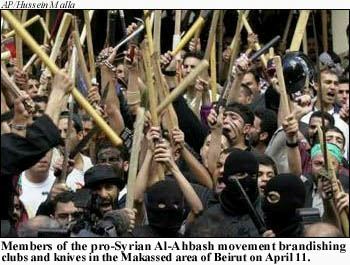
After a number of prominent Sunni Muslim figures in Lebanon expressed opposition to the Syrian Nusayrie occupation, members of al-Ahbash were quickly mobilized by Syrian intelligence to stage a series of rallies on April 11. Dressed in black and wearing face paint and masks, the al-Ahbash members chanted pro-Syrian slogans before the TV cameras while waving nail-encrusted broomsticks, kitchen knives, brass knuckles, chains, axes, old rusted swords and hammers.
The Ahbash are the followers of Abdullah Ibn Muhammad Ibn Yusuf al-Hirari al-Shibi al-Abdari, also known as Abdullah al-Habashi, signifying his Ethiopian origins. Habashi was born in 1920 in al-Hirara, Ethiopia, where he studied Shafii juriprudence and became a Mufti. In 1947, the Habashi was deported to Saudi Arabia by former Ethiopian Emperor Haile Selassie. A year later, the Habashi moved to Damascus to study with the Rafaiiyya and Qadiriyya Sufi orders. In 1950, he made Beirut his home and started a campaign of recruitment. In 1983, his followers took control of the Society of Islamic Philanthropic Projects that was originally formed by Sheikh Ahmad al-Ajuz in 1930.
The Ahbash's belief system mixes elements of Sunni and Shi'ite theological doctrines with Sufi spiritualism. It includes the following tenets that are regularly publicized in Manar al-Huda, the society's journal:
-Islam's pluralist character and opposing the use of violence against the ruling authorities.
-One of the most revealing aspects of Shaykh Habashi's thought is his acceptance of the Shi'a doctrine of legitimacy. He begins by quoting Shafi'i, that everyone who fought 'Ali was a baghi (transgressor). 37 Habashi further cites Ibn Hanbal to jus tify 'Ali's caliphate against Mu'awiya and his "faction of transgressors" (al-firqa al-baghiya) . 38 As a further step, Habashi underlines the legitimacy of all four members of the Prophet's family -Ali, Fatima, Hasan, and Husayn -by citing the canonical writings of Muslim and al-Nisa'i . 39 Equally significant is Shaykh Habashi's rejection of the use of ijtihad by some Sunni jurists to legitimize Mu'awiya's opposition to 'Ali. As a case in point, Habashi takes issue with Ibn Taymiyya's view that fighting with 'Ali against Mu'awiya was neither a duty nor a Sunna. This product of Ibn Taymiyya's ijtihad is found invalid by Habashi because of the presence of a clear Qur'anic text and hadith. In support of his position, Habashi cites the verse "fight the group that is a transgressor," along with the Prophet's hadith warning 'Ammar bin Yasir, a companion of Muhammad and 'Ali, about the faction of transgressors who would kill him. Habashi concludes that "the faction of transgressors" was that of Mu'awiya, and fighting on 'Ali's side was a duty and Sunna . 40 Furthermore, Habashi explicitly disagrees with most contemporary Sunni jurists by citing several ahadith in order to uphold the legitimacy of the imama of 'Ali and of his sons Hasan and Husayn.41 Also, Habashi upholds the teachings of Imam Husayn's son, Zayn al-'Abidin, who is held in high esteem by the Ahbash . 42 Yet, beyond his acceptance of the foregoing doctrinal positions, Habashi's closeness to Shi'ism comes from another source-his deep immersion in Sufism.
-Defending many Sufi beliefs and practices that are condemned by the Muslims as heresies. Such practices include giving allegiances to the pious ancestors, upholding the name of Allah by singing, visiting the shrines of saintly ancestors for their blessing and keeping meditation boxes in the mosques. The Ahbash enjoy the support of three traditional Sufi orders - Qadiriyya, Rifaiiyya, and Naqshabandiyya.
-Tolerating different forms of Islamic expression and opposing the absolutist standards of the Islamists.
-Rejecting the doctrine of Takfir (the charge of unbelief leveled by the Islamists against other Muslims) and emphasizing a relativistic standard in judging individuals and rulers.
Opposing the establishment of Islamic order and the appointment of a caliph as espoused by most Muslims. The Ahbash endorse consociationalism as a political system and oppose the establishment of an Islamic state.