

Aziboy
Banned
Al-Nabahani's Creed

Introduction
Taqi ud-Din an-Nabahani (1909-1977CE) is the founder of the group "Hizb ut-Tahrir", the picture on the right - taken in his early years - indicates the traditional Azhari, Ash'ari early upbringing. He was an Ash'ari in aqidah (mixed with some of usool of the Mu'tazilah, Murji'ah and Qadariyyah). He is of Palestinian origin, coming from a Sufi family background. His maternal grandfather was Yusuf bin Ismaa'eel an-Nabahani, a fervent adherent of Tasawwuf and one who authored a book, "Shawaahid ul-Haqq fil-Istighaathah bi Sayyid il-Khalq", arguing for the justification of seeking and calling upon the Prophet (sallallaahu alayhi wasallam) for rescue from calamity in those things in which only Allaah has power and ability. Given this family background (Ash'ari Sufi with Mu'tazili, Qadariyy usool) it is not surprising to see that in all the books of Taqi ud-Din an-Nabahani, the grandson, the discussion of Tawhid barely extends further than merely affirming Allaah's existence and around nine or ten attributes (which is not the Tawhid that the Messengers came to establish).
Taqi ud-Din an-Nabahani authored a range of books outlining his own political philosophy including "Nidhaam ul-Islaam" and "ash-Shakhsiyyah al-Islaamiyyah". Like those before him such as Hasan al-Banna and Sayyid Qutb, an-Nabahani was an Ash'ari, Maturidi in his aqidah and carried some of the usool of the Mu'tazilah, and Ash'ariyyah in his works. His goal, just like previous Ash'arites such as Hasan al-Banna and Sayyid Qutb, was the restoration of the khilaafah, and he just like them, considered all Muslim lands to be lands of kufr in which a revolution, ideological or otherwise, was obligatory. All of these ideologies of the 20th century came from Ash'ari, Maturidi, [Sufi] agitators who were far away from the creed (aqidah) of the Salaf, and were influenced - in their methodologies of reform - by the practical elements of the prevailing secular ideologies of their time.
In this series we will be highlighting the (deviant) creed of an-Nabahani, indicating his remoteness from the aqidah of Ahl us-Sunnah wal-Jamaa'ah and his agreement with the usool of the Jahmiyyah, the Mu'tazilah, the Ash'ariyyah and his wallowing in the bid'ah of al-Qadr, that of the Qadariyyah, alongside other instances of profound ignorance of the aqidah of the Righteous Salaf (the Companions and their followers). Here are scans of cover pages for two of his (numerous) books which were alluded to earlier:
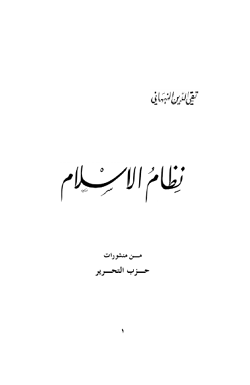
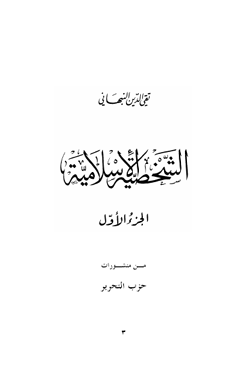
They are the 6th edition of "ash-Shakhsiyyah al-Islaaamiyyah" (Dar ul-Ummah, Beirut, 2003CE) and "Nidhaam ul-Islaam" (6th edition, 2001CE).
Taqi ad-Din an-Nabahani Considers the Atheistic Creed of al-Jahm bin Safwan, the Qadari Creed of Gheelaan al-Dimashqee and the Creeds of the Heads of the Mu'tazilah to be Islamic Creeds in Which There Is No Deviation Under the heading "Philosopher Muslims" in his book "ash-Shakhsiyyah al-Islaamiyyah" (1/125), an-Nabahani writes:
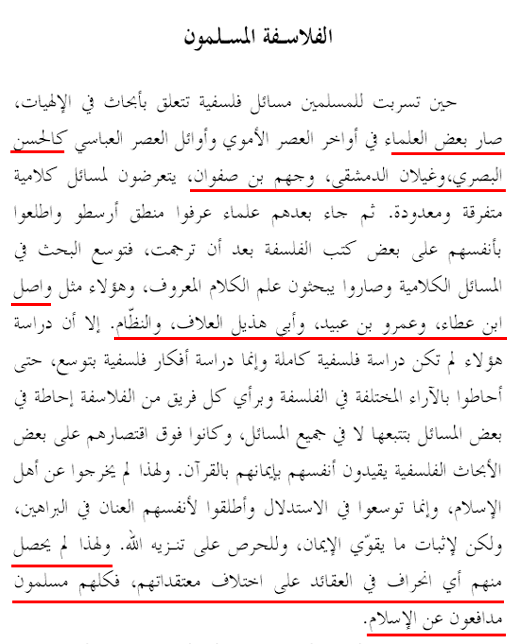
This passage occurs in a wider context of discussing matters of aqidah such as the issue of al-qadaa wal-qadar and Allaah's attributes (sifaat), and here he is outlining what happened between the Philosophers and the theologians (mutakallimoon) by whom he means the Jahmiyyah, Mu'tazilah and Ash'ariyyah.
So he says:
 When philosophical issues connected to studies in divinity were infused amongst the Muslims, some of the Scholars, at the end of the Umayyid era and the beginning of the Abbaasid era, such as al-Hasan al-Basree, Gheelaan ad-Dimashqee and Jahm bin Safwaan began to address numerous different theological issues.
Here he equates between the great and noble Imaam and Taabi'ee, Hasan al-Basree (rahimahullaah) a follower of the Companions, and an Imaam of Ahl us-Sunnah with two heads of innovation and the greatest of deviants. Jahm bin Safwan, who was executed a kaafir in 128H by Salam al-Ahwaz, the amir of Khurasaan, for his kufr and ilhaad (deviation) and Gheelaan al-Qadaree, who along with Ma'bad al-Juhanee was the flag-bearer of the bid'ah of al-Qadar (negating al-Qadar). A quick glimpse into any of the early books of aqidah written by the great Imaams such as Imaam al-Bukhaaree (d. 256H), or Imaam Ahmad (d. 241H) and others and one will see their takfir of al-Jahm and the Jahmiyyah, and their condemnation of the Qadariyyah. There is no excuse for including al-Jahm bin Safwan and Gheelaan al-Qadaree amongst the "scholars".
However, when you read what an-Nabahani says at the end of the above passage (see quote below), you will realize the repugnance of his view. Next, he speaks of those who got involved in philosophy and the logic of Aristotle, he is referring to the heads of the Mu'tazilah, such as Waasil bin Ataa, Amr bin Ubayd, Abu al-Hudhayl al-Allaaf, and an-Nadhaam. He says about these people that they studied philosophical ideas limitedly with a view to defending and strenghtening faith.
It is the view of some that Ibraaheem al-Nadhdhaam was a Hindu from Baraahimah (Brahmans) who rejected prophethood and resurrection and he announced Islam whilst intended its destruction. He then chose I'tizaal (the madhhab of the Mu'tazilah) and used it to infuse philosophical aspects in order to corrupt the deen of the Muslims.
Finally, at the end of the above passage he says about all those mentioned (the heads of the Jahmiyyah, and of the Qadariyyah, and the Mu'tazilah):
For this reason, no deviation at all occurred from them in aqaa'id (beliefs) despite all their variant beliefs, for all of them are Muslims, defending Islaam.
This statement of an-Nabahani indicates either a) his compound ignorance of the Islamic aqidah and of those who deviated from it and of the positions of the great Imaams towards such people b) his deliberate distortion of historical facts and realities. And it is not our purpose here to bring the hundreds of statements from Salaf regarding Jahm bin Safwan or Gheelaan al-Qadariyy or Amr bin Ubayd and their likes from the heads of the Jahmiyyah, Qadariyyah and Mu'tazilah, and the takfir (declaring as disbelievers) of those who held onto the beliefs of these factions. This is rudimentary knowledge for anyone who has studied aqidah from its sources.
An-Nabahani cannot claim ignorance of the position of the Salaf, since either he is guiding himself by those Salaf who followed in the footsteps of the Companions in belief, speech and deed, something that all Muslims are commanded with, or he is guiding himself by something other than that. When one reads the books of an-Nabahani, you do not see him guiding his opinions by the illustrious Imaams of the Sunnah (and you rarely find a mention of them), rather his opinions - as we shall see in the rest of this series - are based upon the views of the Jahmiyyah, the Qadariyyah, the Mu'tazilah and the Ash'ariyyah. So it is little surprise that he defends these heads of innovation in such a manner, claiming that "no deviation at all occurred from them in aqaa'id..."
On page 127 of the same volume, an-Nabahani makes a list of main differences between the Mutakallimeen (theologians, the Jahmiyyah, Mu'tazilah, Ash'ariyyah) and the Philosophers (al-Kindi, al-Farabi, Ibn Seenaa) and he says regarding the Mutakallimeen (the Jahmiyyah, Mu'tazilah and Ash'ariyyah):
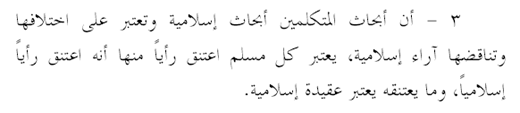
3. That the studies of the theologians are Islamic studies and they are considered, [despite] their divergence and mutual contradiction, as Islamic viewpoints. Every Muslim who embraced a viewpoint from amongst them (those viewpoints) is considered to have embraced an Islamic viewpoint, and whatever he adopted is considered an Islamic aqidah.
This means that the saying that the Qur'an (i.e. the speech of Allaah) is created, which is kufr, is an Islamic aqidah, and the saying that Allaah has no Names or Attributes is an Islamic aqidah, and the saying that man creates his own actions, outside of the domain of Allaah's will and creative ability is an Islamic aqidah, and the saying that man is compelled in his actions, without choice is an Islamic aqidah, and the saying that Allaah has no speech, and never spoke to Moses is an Islamic aqidah, and the saying that Allaah is everywhere within the creation is an Islamic aqidah, and that Allaah is not above His Throne, above His creation is an Islamic aqidah and so on. And that all the great Imaams of the Salaf from the time of the likes of al-Hasan al-Basri (d. 110H) to well into the fourth and fifth centuries, in all their thousands, were all in manifest error in writing books, and warning against these deviant creeds and opinions and their figureheads, and warning against those who spoke with them, expelling them, boycotting them - that the entirety of the Salaf were in manifest error in their position towards these deviant innovators that were the Qadariyyah, Jahmiyyah, Mu'tazilah, Kullaabiyyah. That the books that were authored in this period such as (by way of example):
"Kitaab ul-Eemaan" by the Imaam and mujtahid, Abu 'Ubayd al-Qaasim ibn Salaam (d. 224H)
"Kitaab ul-Eemaan" by the Imaam Ib Abee Shaybah (d. 235H)
"Usool us-Sunnah" by Imaam Ahmad bin Hanbal (d. 241H)
"Kitaab ul-Eeemaan" in the Saheeh by Imaam al-Bukharee (d. 256H).
"Kitaab ut-Tawheed" in the Saheeh by Imaam al-Bukharee (d. 256H).
"As-Sunnah" by the student of Imaam Ahmad, Abu Bakr al-Athram (d. 273H)
"Kitaab us-Sunnah" (being part of the Sunan) by the faqeeh and Imaam Abu Dawood as -Sijistaanee (d. 275H)
"Asl us-Sunnah" by the haafidh and Imaam, Abu Haatim ar-Raazee (d. 277H)
"As-Sunnah" by the qaadee and haafidh, Ibn Abee 'Aasim (d. 287H)
"As-Sunnah" by the haafidh, Abdullah ibn Imaam Ahmad (d. 290H)
"As-Sunnah" by the qaadee and muhaddith AbuBakr al-Marroodhee (d. 292H)
"As-Sunnah" by the student of Imaam Ahmad, al-Marwaazee (d. 292H)
"Sareeh us-Sunnah" by the mujtahid, mufassir and Imaam, Ibn Jareer at-Tabaree (d. 310H)
"Kitaab ut-Tawheed" by the faqeeh and Imaam, Ibn Khuzaymah (d. 311H)
"Aqeedat ut-Tahaawiyyah" by the Imaam Abu Jafar at-Tahaawee (d. 321H)
"Sharh us-Sunnah" by Imaam al-Barbaaharee (d. 329H)
"Kitaab us-Sunnah" by the qaadee, Abu Ahmad al-Asaal (d. 349H)
"Ash-Sharee'ah" by the faqeeh and Imaam, Abu Bakr al-Aajurree(d. 360H)
"Kitaab ut-Tawheed" the haafidh and Imaam, Ibn Mandah (d. 395H)
"Sharh Usool I'tiqaad Ahlus-Sunnah Wal Jamaa'ah" by the haafidh and faqeeh, Imaam al-Laalilkaa'ee (d. 428H)
"Al-I'tiqaad" by Abu Nuaym al-Ashbaanee (d. 430H)
"Aqeedat us-Salaf Ashaabul-Hadeeth" by the haafidh and Imaam, Abu Uthmaan as-Saboonee (d. 449H)
Were all in vain and were all in falsehood, and that all these great Imaams who authored these books were unjust and oppressive against those deviants, because their deviations were nothing but the "Islamic aqidah" despite the mutual contradiction between these creeds!
And this is sufficient to show that an-Nabahani is a wandering strayer, who has demonstrated either his compound ignorance of the Islamic aqidah, his lack of the very intellect he glorifies so much in his works, or his wilful, deliberate attempt to defend falsehood and its people, with full knowledge that all of the Salaf showed scorn and rejection against these people in many written works in the second, third, fourth and fifth centuries after hijrah as indicated above.
However, when we come to look at an-Nabahani's other viewpoints in creed, it becomes clear that he actually is with those deviants, and is with them in their usool, and for this reason, he is very magnanimous towards them, and this explains these excuses he makes for these people who destroyed the unity of the Muslims and aided in the destruction of Islaam and its sanctified aqidah.
Introduction
Taqi ud-Din an-Nabahani (1909-1977CE) is the founder of the group "Hizb ut-Tahrir", the picture on the right - taken in his early years - indicates the traditional Azhari, Ash'ari early upbringing. He was an Ash'ari in aqidah (mixed with some of usool of the Mu'tazilah, Murji'ah and Qadariyyah). He is of Palestinian origin, coming from a Sufi family background. His maternal grandfather was Yusuf bin Ismaa'eel an-Nabahani, a fervent adherent of Tasawwuf and one who authored a book, "Shawaahid ul-Haqq fil-Istighaathah bi Sayyid il-Khalq", arguing for the justification of seeking and calling upon the Prophet (sallallaahu alayhi wasallam) for rescue from calamity in those things in which only Allaah has power and ability. Given this family background (Ash'ari Sufi with Mu'tazili, Qadariyy usool) it is not surprising to see that in all the books of Taqi ud-Din an-Nabahani, the grandson, the discussion of Tawhid barely extends further than merely affirming Allaah's existence and around nine or ten attributes (which is not the Tawhid that the Messengers came to establish).
Taqi ud-Din an-Nabahani authored a range of books outlining his own political philosophy including "Nidhaam ul-Islaam" and "ash-Shakhsiyyah al-Islaamiyyah". Like those before him such as Hasan al-Banna and Sayyid Qutb, an-Nabahani was an Ash'ari, Maturidi in his aqidah and carried some of the usool of the Mu'tazilah, and Ash'ariyyah in his works. His goal, just like previous Ash'arites such as Hasan al-Banna and Sayyid Qutb, was the restoration of the khilaafah, and he just like them, considered all Muslim lands to be lands of kufr in which a revolution, ideological or otherwise, was obligatory. All of these ideologies of the 20th century came from Ash'ari, Maturidi, [Sufi] agitators who were far away from the creed (aqidah) of the Salaf, and were influenced - in their methodologies of reform - by the practical elements of the prevailing secular ideologies of their time.
In this series we will be highlighting the (deviant) creed of an-Nabahani, indicating his remoteness from the aqidah of Ahl us-Sunnah wal-Jamaa'ah and his agreement with the usool of the Jahmiyyah, the Mu'tazilah, the Ash'ariyyah and his wallowing in the bid'ah of al-Qadr, that of the Qadariyyah, alongside other instances of profound ignorance of the aqidah of the Righteous Salaf (the Companions and their followers). Here are scans of cover pages for two of his (numerous) books which were alluded to earlier:
They are the 6th edition of "ash-Shakhsiyyah al-Islaaamiyyah" (Dar ul-Ummah, Beirut, 2003CE) and "Nidhaam ul-Islaam" (6th edition, 2001CE).
Taqi ad-Din an-Nabahani Considers the Atheistic Creed of al-Jahm bin Safwan, the Qadari Creed of Gheelaan al-Dimashqee and the Creeds of the Heads of the Mu'tazilah to be Islamic Creeds in Which There Is No Deviation Under the heading "Philosopher Muslims" in his book "ash-Shakhsiyyah al-Islaamiyyah" (1/125), an-Nabahani writes:
This passage occurs in a wider context of discussing matters of aqidah such as the issue of al-qadaa wal-qadar and Allaah's attributes (sifaat), and here he is outlining what happened between the Philosophers and the theologians (mutakallimoon) by whom he means the Jahmiyyah, Mu'tazilah and Ash'ariyyah.
So he says:
However, when you read what an-Nabahani says at the end of the above passage (see quote below), you will realize the repugnance of his view. Next, he speaks of those who got involved in philosophy and the logic of Aristotle, he is referring to the heads of the Mu'tazilah, such as Waasil bin Ataa, Amr bin Ubayd, Abu al-Hudhayl al-Allaaf, and an-Nadhaam. He says about these people that they studied philosophical ideas limitedly with a view to defending and strenghtening faith.
It is the view of some that Ibraaheem al-Nadhdhaam was a Hindu from Baraahimah (Brahmans) who rejected prophethood and resurrection and he announced Islam whilst intended its destruction. He then chose I'tizaal (the madhhab of the Mu'tazilah) and used it to infuse philosophical aspects in order to corrupt the deen of the Muslims.
Finally, at the end of the above passage he says about all those mentioned (the heads of the Jahmiyyah, and of the Qadariyyah, and the Mu'tazilah):
An-Nabahani cannot claim ignorance of the position of the Salaf, since either he is guiding himself by those Salaf who followed in the footsteps of the Companions in belief, speech and deed, something that all Muslims are commanded with, or he is guiding himself by something other than that. When one reads the books of an-Nabahani, you do not see him guiding his opinions by the illustrious Imaams of the Sunnah (and you rarely find a mention of them), rather his opinions - as we shall see in the rest of this series - are based upon the views of the Jahmiyyah, the Qadariyyah, the Mu'tazilah and the Ash'ariyyah. So it is little surprise that he defends these heads of innovation in such a manner, claiming that "no deviation at all occurred from them in aqaa'id..."
On page 127 of the same volume, an-Nabahani makes a list of main differences between the Mutakallimeen (theologians, the Jahmiyyah, Mu'tazilah, Ash'ariyyah) and the Philosophers (al-Kindi, al-Farabi, Ibn Seenaa) and he says regarding the Mutakallimeen (the Jahmiyyah, Mu'tazilah and Ash'ariyyah):
"Kitaab ul-Eemaan" by the Imaam and mujtahid, Abu 'Ubayd al-Qaasim ibn Salaam (d. 224H)
"Kitaab ul-Eemaan" by the Imaam Ib Abee Shaybah (d. 235H)
"Usool us-Sunnah" by Imaam Ahmad bin Hanbal (d. 241H)
"Kitaab ul-Eeemaan" in the Saheeh by Imaam al-Bukharee (d. 256H).
"Kitaab ut-Tawheed" in the Saheeh by Imaam al-Bukharee (d. 256H).
"As-Sunnah" by the student of Imaam Ahmad, Abu Bakr al-Athram (d. 273H)
"Kitaab us-Sunnah" (being part of the Sunan) by the faqeeh and Imaam Abu Dawood as -Sijistaanee (d. 275H)
"Asl us-Sunnah" by the haafidh and Imaam, Abu Haatim ar-Raazee (d. 277H)
"As-Sunnah" by the qaadee and haafidh, Ibn Abee 'Aasim (d. 287H)
"As-Sunnah" by the haafidh, Abdullah ibn Imaam Ahmad (d. 290H)
"As-Sunnah" by the qaadee and muhaddith AbuBakr al-Marroodhee (d. 292H)
"As-Sunnah" by the student of Imaam Ahmad, al-Marwaazee (d. 292H)
"Sareeh us-Sunnah" by the mujtahid, mufassir and Imaam, Ibn Jareer at-Tabaree (d. 310H)
"Kitaab ut-Tawheed" by the faqeeh and Imaam, Ibn Khuzaymah (d. 311H)
"Aqeedat ut-Tahaawiyyah" by the Imaam Abu Jafar at-Tahaawee (d. 321H)
"Sharh us-Sunnah" by Imaam al-Barbaaharee (d. 329H)
"Kitaab us-Sunnah" by the qaadee, Abu Ahmad al-Asaal (d. 349H)
"Ash-Sharee'ah" by the faqeeh and Imaam, Abu Bakr al-Aajurree(d. 360H)
"Kitaab ut-Tawheed" the haafidh and Imaam, Ibn Mandah (d. 395H)
"Sharh Usool I'tiqaad Ahlus-Sunnah Wal Jamaa'ah" by the haafidh and faqeeh, Imaam al-Laalilkaa'ee (d. 428H)
"Al-I'tiqaad" by Abu Nuaym al-Ashbaanee (d. 430H)
"Aqeedat us-Salaf Ashaabul-Hadeeth" by the haafidh and Imaam, Abu Uthmaan as-Saboonee (d. 449H)
Were all in vain and were all in falsehood, and that all these great Imaams who authored these books were unjust and oppressive against those deviants, because their deviations were nothing but the "Islamic aqidah" despite the mutual contradiction between these creeds!
And this is sufficient to show that an-Nabahani is a wandering strayer, who has demonstrated either his compound ignorance of the Islamic aqidah, his lack of the very intellect he glorifies so much in his works, or his wilful, deliberate attempt to defend falsehood and its people, with full knowledge that all of the Salaf showed scorn and rejection against these people in many written works in the second, third, fourth and fifth centuries after hijrah as indicated above.
However, when we come to look at an-Nabahani's other viewpoints in creed, it becomes clear that he actually is with those deviants, and is with them in their usool, and for this reason, he is very magnanimous towards them, and this explains these excuses he makes for these people who destroyed the unity of the Muslims and aided in the destruction of Islaam and its sanctified aqidah.