Waves under ocean

noor aldeen

Junior Member
:salam2:


http://www.kaheel7.com/ar/images/stories/85282828285.JPG
The holy Qur’an referred to a new scientific discovery that is in the deep of oceans there are waves and dark, let us read …
http://www.kaheel7.com/userimages/wave_ocean.jpg
Scientists discovered that in the deep of oceans there are deep waves which are different from surface waves. Allah Almighty makes the parable of deeds of atheists and disbelievers as a man who lives in the deep of the sea where he is covered by a layer of deep waves that is covered by a layer of surface waves which is covered by darkness, this likeningis to demonstrate how those atheists by their deeds are far from the light of Allah (following principles and orders of Islam).


Allah Almighty says “ (Or [the state of a disbeliever] is like the darkness in a vast deep sea, overwhelmed with a great wave topped by a great wave, topped by dark clouds, darkness, one above another, if a man stretches out his hand, he can hardly see it! And he for whom Allah has not appointed light, for him there is no light.){Sûrat An-Nûr -The Light –verse 40}.

Glory to Allah, recent scientists found that discovery in 2007 and they didn’t expect that finding. Who told prophet Mohamed peace be upon him about the deep waves? Allah is the teller who says about Himself: ((He Alone) the All-Knower of the Gha'ib (unseen), and He reveals to none His Gha'ib (unseen).*Except to a Messenger (from mankind) whom He has chosen (He informs him of unseen as much as He likes)){Sûrat Al-Jinn -The Jinn -verse26-27
 

JenGiove

Junior Member
[SIZE=+1]The discovery of these waves isn't new...tho, its not quite as old as the Qur'an.. :)[/SIZE][SIZE=+1]

[/SIZE]
http://en.wikipedia.org/wiki/Dead_water
Dead water
is the nautical term for a strange phenomenon which can occur when a layer of fresh or brackish water rests on top of denser salt water, without the two layers mixing. A ship traveling in such conditions may be hard to maneuver or can even slow down almost to a standstill. Much of the energy from the ship's propeller only results in waves and turbulence between the two layers of water, leaving a ship capable of traveling at perhaps as little as 20% of its normal speed.[citation needed]
The phenomenon was first described by Fridtjof Nansen, the Norwegian Arctic explorer. Nansen wrote the following from his ship Fram in August 1893 in the Nordenskiöld Archipelago near the Taymyr Peninsula:

  • "When caught in dead water Fram appeared to be held back, as if by some mysterious force, and she did not always answer the helm. In calm weather, with a light cargo, Fram was capable of 6 to 7 knots [1]. When in dead water she was unable to make 1.5 knots [2]. We made loops in our course, turned sometimes right around, tried all sorts of antics to get clear of it, but to very little purpose."[citation needed]
This phenomenon is observable where glacier runoff flows into salt water without much mixing, such as in fjords.
[SIZE=+1]Here is the more scientific explanation..
[/SIZE][SIZE=+1]
Internal waves are a class of gravity waves to be found almost entirely under the surface. They propagate along the boundaries of layers of water with differing densities:
  • A thermocline forms when the sea heats up. Warm water being lighter than cold water, remains on top. A temperature gradient develops into a sharp thermocline. The water on top may be 4 degrees warmer and 0.2% less dense.
  • Fresh water flowing from large rivers, is lighter than salt water and stays on top of it for many kilometres and several metres depth. In fiords, the fresh water may form a 5m deep layer. The fresh water is about 3.5% less dense.
Because of the small difference in density between such layers, the corresponding restoring force for gravity waves is much less than that for surface waves (which is the weight difference between water and air). From the speed equation for gravity waves, it follows that internal waves move much more slowly but at a fixed rate, which also depends on the depth of the boundary layer. For instance, for a thermocline at 10m with a difference of 0.15% density, the wave velocity would be 0.4m/s (1.4 km/hr). For a fresh water layer of 5m depth, the wave velocity would be 1.3 m/s (6.1 km/hr).
Internal waves require very little energy to be set in motion. The tidal current flowing over a sea bottom discontinuity could create packets of internal waves. Internal wave amplitudes of tens of metres and periods of up to 12 hours have been measured in the open ocean. Internal waves can also produce standing waves (like seiches) in enclosed bays. Because these waves are difficult to observe, very little is known about them.

[SIZE=-1]The wave phase velocity of gravity waves in a two layer ocean is given by:[/SIZE]
[SIZE=-1]c x c = g x d x (p2 - p1) / p2[/SIZE]
[SIZE=-1]where c = phase velocity (m/s), g = acceleration of gravity (9.8 m/s/s), d = thickness of the upper layer (m)[/SIZE]
[SIZE=-1]p1 = density of top layer (g/cm/cm), p2 = density of deep layer (g/cm/cm).[/SIZE]​
[SIZE=-1]From this formula it follows that the wave velocity of internal waves depends both on the thickness of the layer and the relative difference in density between the two layers.[/SIZE]
[SIZE=-1]It is interesting to note that the water particles above the layer move clockwise whereas those below move counter clockwise.[/SIZE]
ocean45.gif
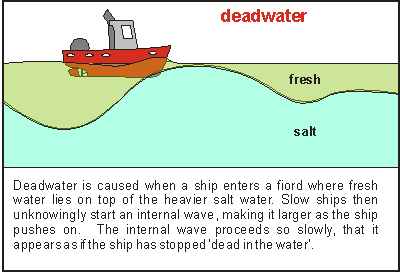
[SIZE=-1]Although they did not know what caused it, seamen were familiar with a strange phenomenon, called deadwater. When travelling into a fiord, or near an ice shelf, their slow ships seemed to come to a halt, and even at full power they would only make very slow headway. Later, scientists discovered its cause, an internal wave created by the ship's movement. It appears as if the ship is travelling uphill against the heavier salt water crest. A 1000 tonne ship could experience it as a 20 tonne drag, because salt water of 3.5% is about 2% denser than fresh water. [/SIZE] [SIZE=-1]Internal waves arising from temperature or saline differences, can reach magnitudes of 40m, bringing deep nutrient-rich water right into the shallow light zone where it causes sudden and dense plankton blooms. [/SIZE]
[SIZE=-1]The polar explorer Fridtjof Nansen, leader of the Norwegian North Polar expedition to the Arctic in 1893-1896 reported the following experience aboard the small research vessel Fram, as he was tracking the ice dirft across the Arctic:[/SIZE]
[SIZE=-1]On tuesday, August 29th, 1893, the Fram got into open water in the sound between the Isle of Taimur and the Almvist Islands and steamed in calm water through the sound to the north-east. . . . We approached the ice to make fast to it, but the Fram had got into dead-water, and made hardly any way, in spite of the engine going at full pressure. It was such slow work that I thought I would row ahead to shoot seal. . . . the speed must have reduced to 1 - 1.5 knot in the dead-water. . . The water at the surface was almost fresh, whereas through the bottom-cock of the engine room we got perfectly salt water.[/SIZE] [SIZE=-1]In 1963, the nuclear submarine USS Thresher was lost with all hands on board. Prior to the sinking there had been no indication of equipment malfunction or unusual storm weather. While submerged, submarines attain neutral buoyancy by flooding or jettisoning seawater from a series of ballast tanks. An effective way for a submarine to avoid detection by suface vessels is to dive and cruise silently along density discontinuities (pycnoclines), which tend to reflect the engine noise downward and sonar pulses from above upward. Navy scientists speculate that the USS Thresher was probably cruising along a pycnocline when it encountered a large internal wave. Because of its neutral buoyancy, it is thought that the submarine suddenly slid down the wave's back side, down to greater depths. Unable to compensate for this sudden fall, the submarine exceeded its design depth and imploded with loss of all life.[/SIZE]
[SIZE=-1]Source: Paul R Pinet: Oceanography.1992.[/SIZE]
 

noor aldeen

Junior Member
:wasalam: Brother,

The sentiment is wonderful but since I'm not a Muslim, I doubt that your other brothers and sisters would agree... :)

:salam2:
thank my sister for passing by i hope you are well and having good time
allah will take care of you
:astag:
 

JenGiove

Junior Member
:salam2:
thank my sister for passing by i hope you are well and having good time
allah will take care of you
:astag:

:salam2: Aside from some dental issues and the recent anniversary of the passing of my father and brother, I'm well...

Be well Brother..
 

noor aldeen

Junior Member
:salam2: Aside from some dental issues and the recent anniversary of the passing of my father and brother, I'm well...

Be well Brother..

my sister take care of you self and allah mercy for them make doa and give mony as cherity for their soul to poor people allah mery on them
:salam2:

الغالي ما ينعرف غير لا غاب ،،


و الحبيب تعرف قيمته لا فقدته ،،


ماني بمشاعر الغلا كذاب و لعاب ،،


و لاني منافق بحب اللي عرفته ،،


أبياتي ما تمدح غير عزيزين و أحباب،،


"وانا ما ارسل لغير اللي أعزه"
 
Top