Al-'Abasa - pls assist to tafseer this sura'

Hard Rock Moslem

I'm your brother
Can anyone help me to tafseer Sura' Al-'Abasa (80: 1 - 11). Was this sura' was targeted at Holy Propthet (peace and blessings be upon Him) for ignoring a blind or for someone else? My ustaz clarified that The Prophet (peace and blessings be upon Him) will never do that to a blind and as He is the best example to all ummah. Pls assist me.
 

Al-Kashmiri

Well-Known Member
Staff member
As-salaamu `alaykum warahmatullaahi wabarakaatuh.

What your Ustadh said requires proof from the shari`ah, Muhammad sall-Allaahu `alayhi wasallam was the best of mankind, yet he was from mankind and behaved as such.

More than one of the scholars of Tafsir mentioned that one day the Messenger of Allah was addressing one of the great leaders of the Quraysh while hoping that he would accept Islam. While he was speaking in direct conversation with him, Ibn Umm Maktum came to him, and he was of those who had accepted Islam in its earliest days. He (Ibn Umm Maktum) then began asking the Messenger of Allah about something, urgently beseeching him. The Prophet hoped that the man would be guided, so he asked Ibn Umm Maktum to wait for a moment so he could complete his conversation. He frowned in the face of Ibn Umm Maktum and turned away from him in order to face the other man. Thus, Allah revealed...​

See http://www.tafsir.com/default.asp?sid=80&tid=57084 for the complete tafsir.
 

Hard Rock Moslem

I'm your brother
Thank you bro. The ustaz quoted following kitab as referrence to support his argument: Al-Qurtubi, Ahkam Al-Qur'an X page 7003, Al-Razi, Mafatih al-Ghayb, *!*!*!I, pg55, Qadi 'Iyad, al-Syifa, II pg.365-366, Al-Tabarsi, Majma' al-Bayan, X pg.437. He also quoted that "Jaafar al-Sadiq" has vehemently denied that Holy Prophet was the one turned away from Umm Maktum instead one of Qurasy from Bani Umaiyyah. Meantime, the ustaz also threw this question to me which I was struggling to answer "if you say it is Muhammad (may blessing and peace be upon Him) is the one was turning away with sour face from this blind man, is this an ahlaq of a Prophet who are are suppose to be "maksum?". Of course I will disagree but Quran that I read most of it gives the same translation. Honestly, I do not have access to all those kitab highlighted above and I don't think I will have a chance to meet this ustaz who is also a professor in local university. Can anyone elaborate further.

 

pcozzy

Junior Member
:salam2:

just a reminder:

The prophet PBUH even if it was or is a mistake is of lesson and benefit to mankind. Allah swt perfected this religion. Any mistakes made by the prophet Allah swt knew before they were even going to be made.

أعوذ بالله من الشيطان الرجيم
Aoothu billahi min a shatani ar rageem

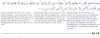
attachment.php


:wasalam:
 

Attachments

  • screenshot2.png
    screenshot2.png
    51.2 KB · Views: 57

hassana elkoussi

Junior Member
:salam2: I do agree with all that my brothers and sisters stated here: It was a mistake made by the Prophet (PBUH) , but it was meant to be a lesson for everybody. The Prophet actually thought that if the leaders of Quraish were to embrace Islam , all their followers will embrace it too. However, Allah swt wanted to teach us through this incident that the most honourable to Allah are the most pious, that no Moslem should be underestimated for any reason whatsoever, not even for the sake of Dawah ( calling for Islam) . The most important point though is that these ayahs are a living proof that the Quran is nothing but the words of Allah. Some people claimed, and still do, that the Quran was made up by Prophet Mohammed ( PBUH) as amixture of the rulings found in Judaism and Christianity.But this ayah along with some others in the Quran - where Allah swt blames the Prophet ( PBUH) for some incidents - proves otherwise, for how can the Prophet make up ayahs blaming himself.At the same time, it's another proof of the extreme honesty of the Prophet ( pbuh) that he kept these ayahs as they are to show his mistakes as a human to all generations.

Hope these points can help in yr argument. Salam
 

salahdin

Junior Member

PLEASE BROTHER YOU DONT NEED TO PROOF THAT YOU ARE RIGHT, FOR WE ARE NOT QUALIFIED NOR DO WE HAVE THAT KNOWLEGE TO DEBATE ON THIS ISSUES . AND BESIDE THAT LET NOT SHAITAN CREATE HOSTILITY BETWEEN YOU TWO.


Nay, verily, this is but a reminder and so, whoever is willing may remember Him in the light of His revelations blest with dignity, lofty and pure, borne by the hands of messengers, noble and most virtuous.' (Surah Abasa 8O: 116).

These are the sixteen verses which were revealed to the noble Prophet about Abdullah ibn Umm Maktum, sixteen verses that have continued to be recited from that time till today and shall continue to be recited.

From that day the Prophet (S.A.W) did not cease to be generous to Abdullah ibn Umm Maktum, to ask him about his affairs, to fulfill his needs and take him into his council whenever he approached. This is not strange. Was he not censured by God in a most severe manner on Abdullah's account? In fact, in later years, he often greeted Ibn Umm Maktum with these words of humility:


Welcome unto him on whose account my Sustainer has rebuked me." When the Quraysh intensified their persecution of the Prophet and those who believed with him, God gave them permission to emigrate. Abdullahs response was prompt. He and Musab ibn Umayr were the first of the Companions to reach Madinah.
 

Hard Rock Moslem

I'm your brother
Minor corrections: The soora's name is `Abasa, not Al-`Abasa and the word is Ma`soom not Maksum. Ma`soom does not mean he cannot make a mistake; it means he has been protected from harm.

The prophet peace be upon him used to say to ibn Umm Maktoom whenever he saw him, "Welcome to him about whom God has blamed me!"

Thank you brother. I just check the spelling for the soora you right, it is my mistake. On maksum, this is how it is spell in my country. Thanks for correcting me.
 
Top