Istikharah: The Guidance Prayer
We are humans, powerless in this sphere of life, knowledgeable only enough to survive. So why shouldn't we turn to Allah and seek His perfect help whenever we require it? Allah responds to the call of His servant when he asks for guidance, and we are after all seeking to do something in order to please Him.
Istikharah means to ask Allah to guide you to the path best for you concerning an affair with two halal options. In matters that are wajib (obligatory), haram (forbidden) or makruh (disliked) there is no need to pray Istikharah. Salaat-ul-Istikharah should only be used for matters that are mubah (allowed) or in matters that are mustahabb (liked or encouraged), in which there is a decision to be made as to which one should be given priority (i.e. get married or go to grad school).
Many wrong notions exist concerning istikharah. Many Muslims will pray, read the du'a, and run to bed expecting to see a dream showing them their future wife, what her favourite colour is, and some other weird fantasy. That is not the purpose of this salat.
The results of an istikharah can take many forms. Basically, you go by your feelings, whether you now feel more favourable or not. Also, you may notice events have changed, either for or against you. Note that you must follow the results of an istikharah, because not doing so is tantamount to rejecting Allah's guidance once you've asked for it. Also, you should firstly clear your mind, not have your mind already decided, and then afterwards follow the results willingly.
It is a sunnah that, if one must choose between permissible alternaratives, one may pray two non-obligatory rak'at, even if they are of the sunnah prayers or a prayer for entering the mosque, and so on, during any time of the day or night, and to recite therein whatever one wishes of the Qur'an after reciting al-Fatihah. Then one praises Allah and sends salutations to the Prophet and recites the supplication in the Hadith below.
The description of Salaat al-Istikhaarah was reported by Jaabir ibn ‘Abd-Allaah al-Salami (may Allaah be pleased with him) who said:
“The Messenger of Allaah
 (peace and blessings of Allaah be upon him) used to teach his companions to make istikhaarah in all things, just as he used to teach them soorahs from the Qur’aan. He said: ‘If any one of you is concerned about a decision he has to make, then let him pray two rak’ahs of non-obligatory prayer, then say:
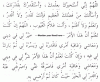
Allaahumma inni astakheeruka bi ‘ilmika wa astaqdiruka bi qudratika wa as’aluka min fadlika, fa innaka taqdiru wa laa aqdir, wa ta’lamu wa laa a’lam, wa anta ‘allaam al-ghuyoob. Allaahumma fa in kunta ta’lamu haadha’l-amra (then the matter should be mentioned by name) khayran li fi ‘aajil amri wa aajilihi (or: fi deeni wa ma’aashi wa ‘aaqibati amri) faqdurhu li wa yassirhu li thumma baarik li fihi. Allaahumma wa in kunta ta’lamu annahu sharrun li fi deeni wa ma’aashi wa ‘aaqibati amri (or: fi ‘aajili amri wa aajilihi) fasrifni ‘anhu [wasrafhu ‘anni] waqdur li al-khayr haythu kaana thumma radini bihi
(O Allaah, I seek Your guidance [in making a choice] by virtue of Your knowledge, and I seek ability by virtue of Your power, and I ask You of Your great bounty. You have power, I have none. And You know, I know not. You are the Knower of hidden things. O Allaah, if in Your knowledge, this matter (then it should be mentioned by name) is good for me both in this world and in the Hereafter (or: in my religion, my livelihood and my affairs), then ordain it for me, make it easy for me, and bless it for me. And if in Your knowledge it is bad for me and for my religion, my livelihood and my affairs (or: for me both in this world and the next), then turn me away from it, [and turn it away from me], and ordain for me the good wherever it may be and make me pleased with it.”
(Reported by al-Bukhaari, 6841; similar reports are also recorded by al-Tirmidhi, al-Nisaa’i, Abu Dawood, Ibn Maajah and Ahmad).
Ibn Hijr (may Allaah have mercy on him) said, commenting on this hadeeth:
“Istikhaarah is a word which means asking Allaah to help one make a choice, meaning choosing the best of two things where one needs to choose one of them.
Concerning the phrase ‘The Messenger of Allaah :saw; (peace and blessings of Allaah be upon him) used to teach us to make istikhaarah in all things,’ Ibn Abi Jamrah said: ‘It is a general phrase which refers to something specific. With regard to matters that are waajib (obligatory) or mustahabb (liked or encouraged), there is no need for istikhaarah to decide whether to do them, and with regard to matters that are haraam (forbidden) or makrooh (disliked), there is no need for istikhaarah to decide whether to avoid them. The issue of istikhaarah is confined to matters that are mubaah (allowed), or in mustahabb matters when there is a decision to be made as to which one should be given priority.’ I say: it refers to both great and small matters, and probably an insignificant issue could form the groundwork for a big issue.
The phrase ‘If any one of you is concerned…’ appears in the version narrated by Ibn Mas’ood as: ‘if any one of you wants to do something…’
‘Let him pray two rak’ahs of non-obligatory prayer.’ This is mentioned to make it clear that it does not mean fajr prayer, for example. Al-Nawawi said in al-Adhkaar: He can pray istikaarah after two rak’ahs of regular sunnah prayer done at zuhr for example, or after two rak’ahs of any naafil prayers whether they are regularly performed or not… It seems to be the case that if he made the intention to pray istikhaarah at the same time as intending to pray that particular prayer, this is fine, but not if he did not have this intention.
Ibn Abi Jamrah said: The wisdom behind putting the salaat before the du’aa’ is that istikhaarah is intended to combine the goodness of this world with the goodness of the next. A person needs to knock at the door of the King (Allaah), and there is nothing more effective for this than prayer, because it contains glorification and praise of Allaah, and expresses one's need for Him at all times.
The phrase ‘then let him say’ would seem to imply that the du’aa’ should be said after finishing the prayer, and the word thumma (then) probably means after reciting all the words of the salaat and before saying salaam.
The phrase ‘O Allaah, I seek Your guidance by virtue of Your knowledge’ is explaining ‘because You know best.’ Similarly, ‘by virtue of Your power’ most likely means ‘seeking Your help.’ ‘I seek ability’ (astaqdiruka) means ‘I ask You to give me the power or ability (qudrah) to do’ whatever is being asked for, or it probably means ‘I ask You to decree (tuqaddir) this for me.’ So it may mean making it easy.
‘I ask You of Your great bounty’ refers to the fact that Allaah gives out of His great generosity, but no one has the right to His blessings. This is the opinion of Ahl al-Sunnah.
‘You have power, I have none. And You know, I know not’ refers to the fact that power and knowledge belong to Allaah alone, and the slave has no share of them except what Allaah decrees for him.
‘O Allaah, if in Your knowledge this matter…’ According to one report, he should mention it by name. It is apparent from the context that he should state it, but it is probably sufficient to be thinking of the matter whilst making this du’aa’.
‘Then ordain it for me’ means ‘make it happen for me’ or it may mean ‘make it easy for me.’
‘Then turn it away from me, and turn me away from it’ means ‘so that my heart will no longer feel attached to it after it has been turned away.’
‘Make me pleased with it’ means ‘make me content with it, so that I will never regret asking for it or be sorry that it happened, because I do not know how it will turn out, even if at the time of asking I am pleased with it.’
The secret is that one’s heart should not be attached to the matter in question, because that will result in a person becoming restless. Being pleased with something means that one’s heart is content with the decree of Allaah.
(Summarized from the commentary of al-Haafiz Ibn Hijr (may Allaah have mercy on him) on the hadeeth in Saheeh al-Bukhaari, Kitaab al-Da’waat and Kitaab al-Tawheed.).
Salat-ul-Istikharah is just two rakats of a non-obligatory prayer, prayed at anytime during the day, with a specific dua at the end. While reciting the dua, you should be thinking about the situation you want to be advised about with pure intentions and from the bottom of your heart. And Allah says that whenever he guides a heart aright it can never be misguided. Afterwards, you should 'have a good feeling' about one of your options. Whatever option you feel is best right after you say the dua should be your decision. If you're still in doubt, you can repeat.
An-Nawawi holds that
"...after performing the istikharah, a person must do what he is wholeheartedly inclined to do and feels good about doing and should not insist on doing what he had desired to do before making the istikharah. And if his feelings change, he should leave what he had intended to do, otherwise he is not completely leaving the choice to Allah, and would not be honest in seeking aid from Allah's power and knowledge. Sincerity in seeking Allah's choice, means that one should completely leave what he himself had desired or determined."
Some people mistakenly wait for a dream to give a clear sign as to what decision to make, but this is not true, and often times it never really happens. In fact, dreams may lead you away from what Allah wants you to do, as Shaytan might try to deceive you in your dreams.
Salat-ul-Istikharah is for everybody. It's a way for all of us to implore Allah for divine guidance and mercy. It is yet another invaluable resource from Allah to keep us on the straight and narrow Sirat al-Mustaqim. The Prophet told all Muslims about Istikharah, not just the scholars. Despite this gift, too many of us take the advice of our friends and parents, or accept the norms of our society and act without ever wondering what Allah wants us to do. We must stop looking to the dunya for guidance. We must begin to consult Allah.
I cannot provide a better conclusion than saying that you must put your trust in Allah. You must have trust in His concern for us, and His ability to help us. Allah says:
"Put your trust in Allâh, certainly, Allâh loves those who put their trust (in Him)." [Surah Al-Imran Ayah 159]